STCA-MobileViTv3: Fish Feeding Intensity Recognition
Abstract
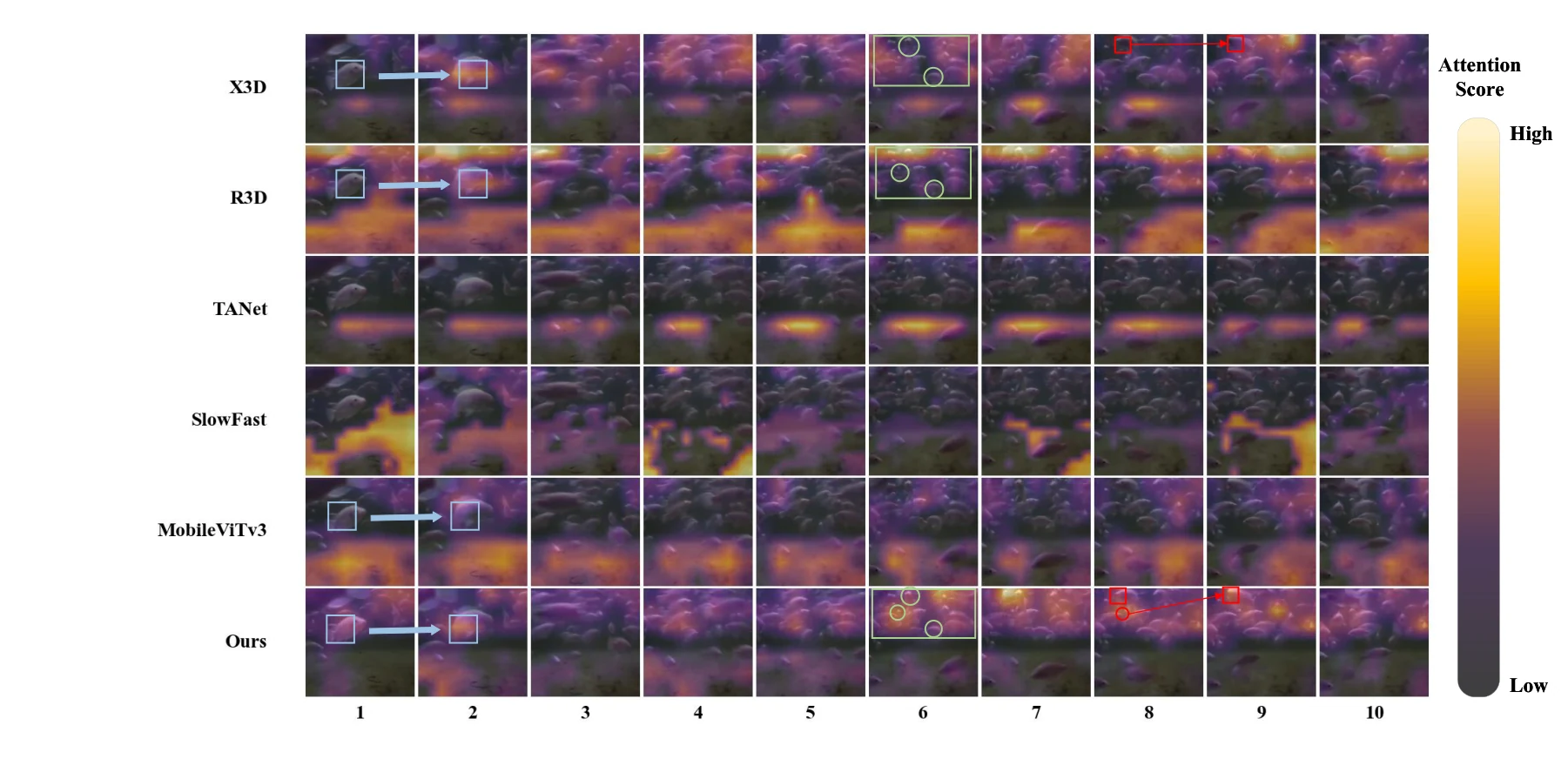
Recognizing fish feeding intensity can inform more precise feeding. Underwater video captures changes in school behavior, but reflections, occlusion, uneven lighting, and redundant frames make those changes hard to isolate. Built on MobileViTv3-XXS, STCA-MobileViTv3 combines key-frame selection, feeding-region localization, and motion modeling across adjacent frames to classify tilapia feeding into four intensity levels. On the study dataset, the model averaged 96.88% accuracy and an F1 score of 0.9598 over ten runs.
Model architecture
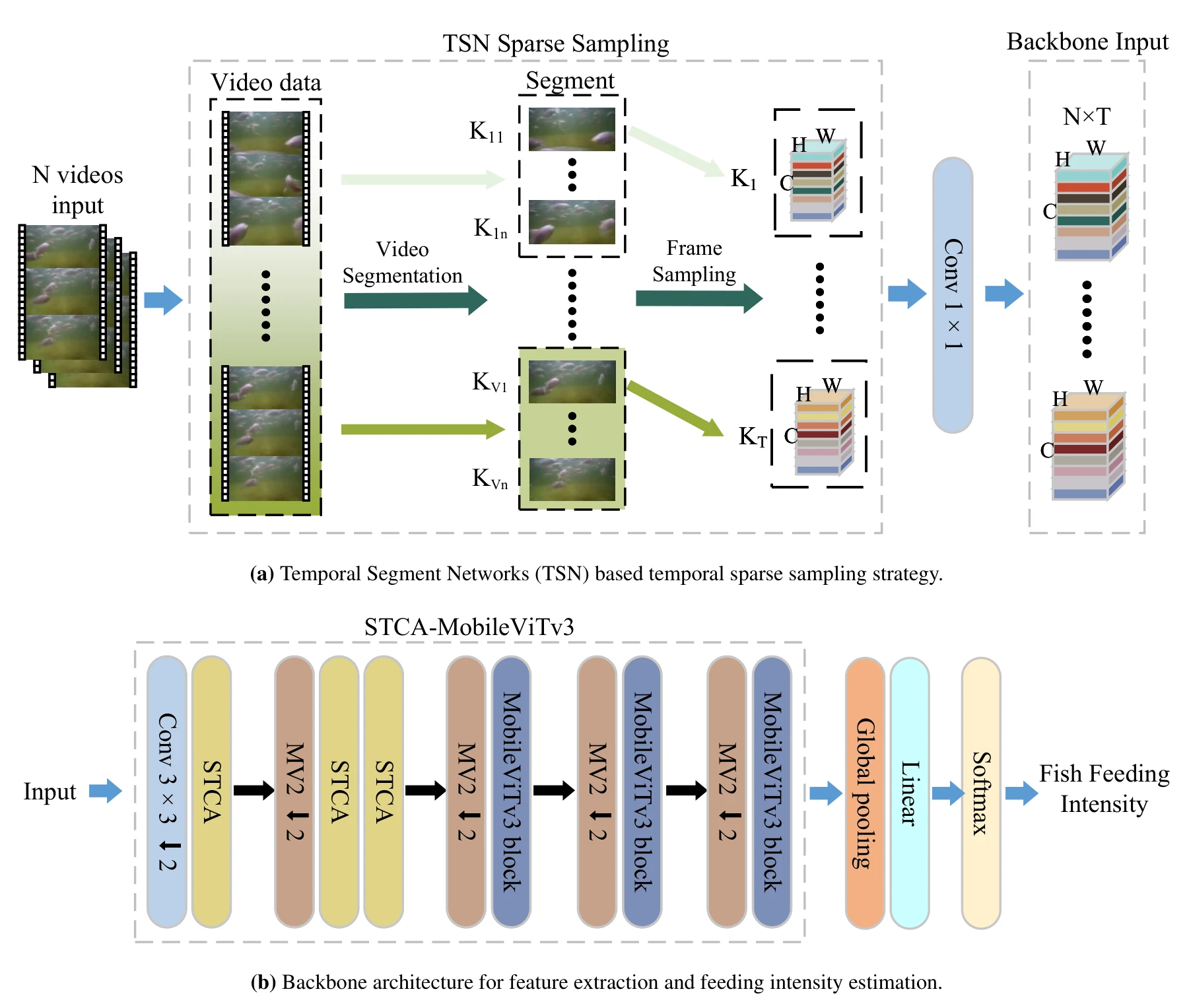
The model divides each five-second underwater clip into temporal segments, samples representative frames, and feeds them to a lightweight backbone with STCA modules. It predicts one of four levels: strong, moderate, weak, or none.
Research contributions
- Underwater video dataset. Collected 797 five-second clips of tilapia, covering strong, moderate, weak, and no feeding.
- Three-branch spatiotemporal attention. Temporal Attention Gating (TAG) downweights redundant frames, Multi-Scale Coordinate Attention (MSCA) locates feeding regions at different scales, and Spatial Motion Excitation (SME) captures changes between adjacent frames.
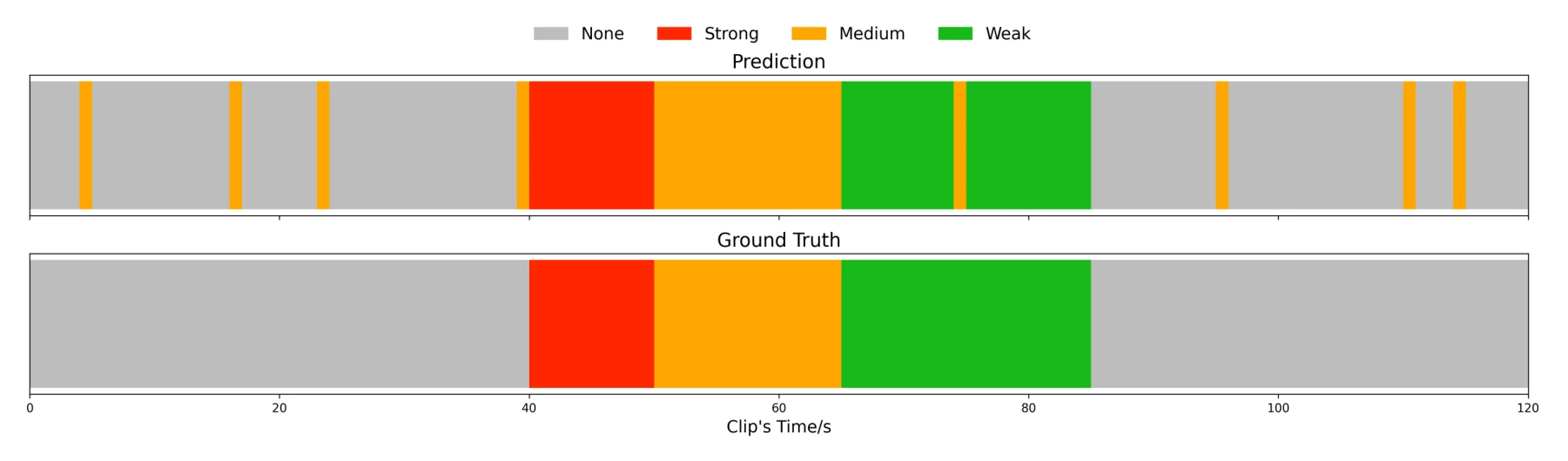
- Edge and continuous-video evaluation. Measured inference speed on OrangePi Plus5 and compared predictions on unseen continuous footage with expert labels.
My contribution
First author. I contributed to experimental design, data analysis, and writing the paper.
Results
Mean accuracy improved by 6.88 percentage points over the MobileViTv3 baseline. The model has about 1.431 million parameters and ran at 34 FPS on OrangePi Plus5. On an unseen 120-second video, the predictions agreed with expert labels for 112 seconds (93.3%).