DF-MobileNetV4: Underwater Fish Feeding Behavior Recognition
Abstract
Underwater cameras avoid surface reflections, but fish aggregation, dispersal, and occlusion make feeding intensity difficult to classify with single-scale image features. DF-MobileNetV4 adds dual-scale adaptive attention and a fused convolutional block to MobileNetV4 to classify individual underwater images into four feeding levels. It achieved 95.59% accuracy on RASUFI. The paper’s structured-pruning variant achieved 96.49% while reducing the model size from 15.4 MB to 12.5 MB.
Model architecture
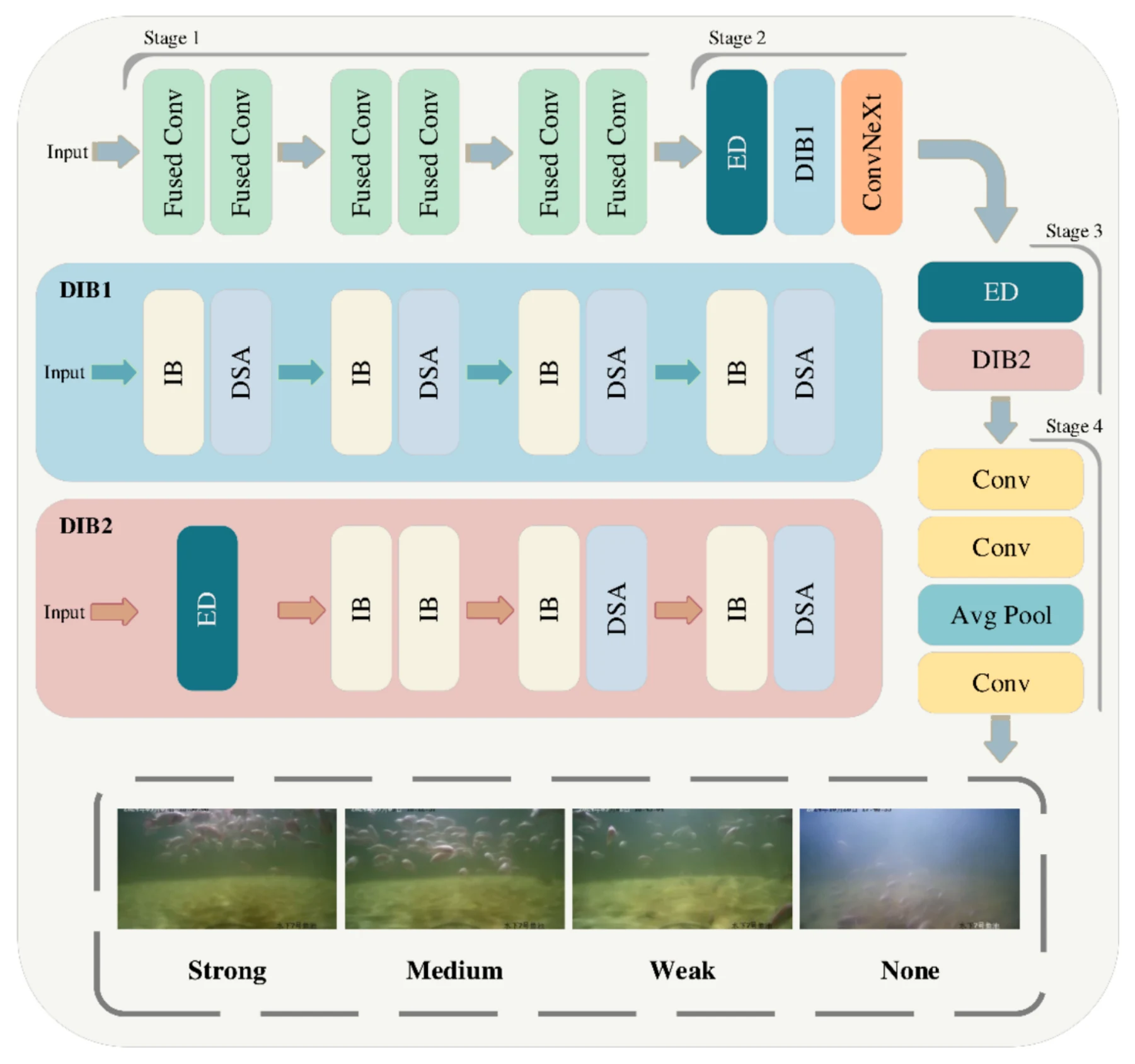
The network has four stages. Fused convolutions extract initial features. The middle stages use dual-scale attention blocks to refine features at different scales. The final stage aggregates those features and predicts strong, moderate, weak, or no feeding.
Research contributions
- Dual-Scale Adaptive Attention (DSA). Models channel information and local spatial positions in parallel to capture fish aggregation, dispersal, and occlusion at multiple scales.
- Fused ConvBlock. Expands channels dynamically to improve feature representation, helping distinguish adjacent feeding levels in turbid water.
- Dataset and structured pruning. Introduced RASUFI, a dataset of 4,944 annotated underwater images, and evaluated recognition performance after pruning the model.
My contribution
I contributed to formal analysis, validation, and visualization, including figures for the paper.
Results
On RASUFI, DF-MobileNetV4 reached 95.59% accuracy, 2.70 percentage points above the MobileNetV4 baseline of 92.89%. The paper also reports 99.09% accuracy on a separate underwater laboratory dataset and 93.75% on AFFIA3K, a public dataset with a surface view.
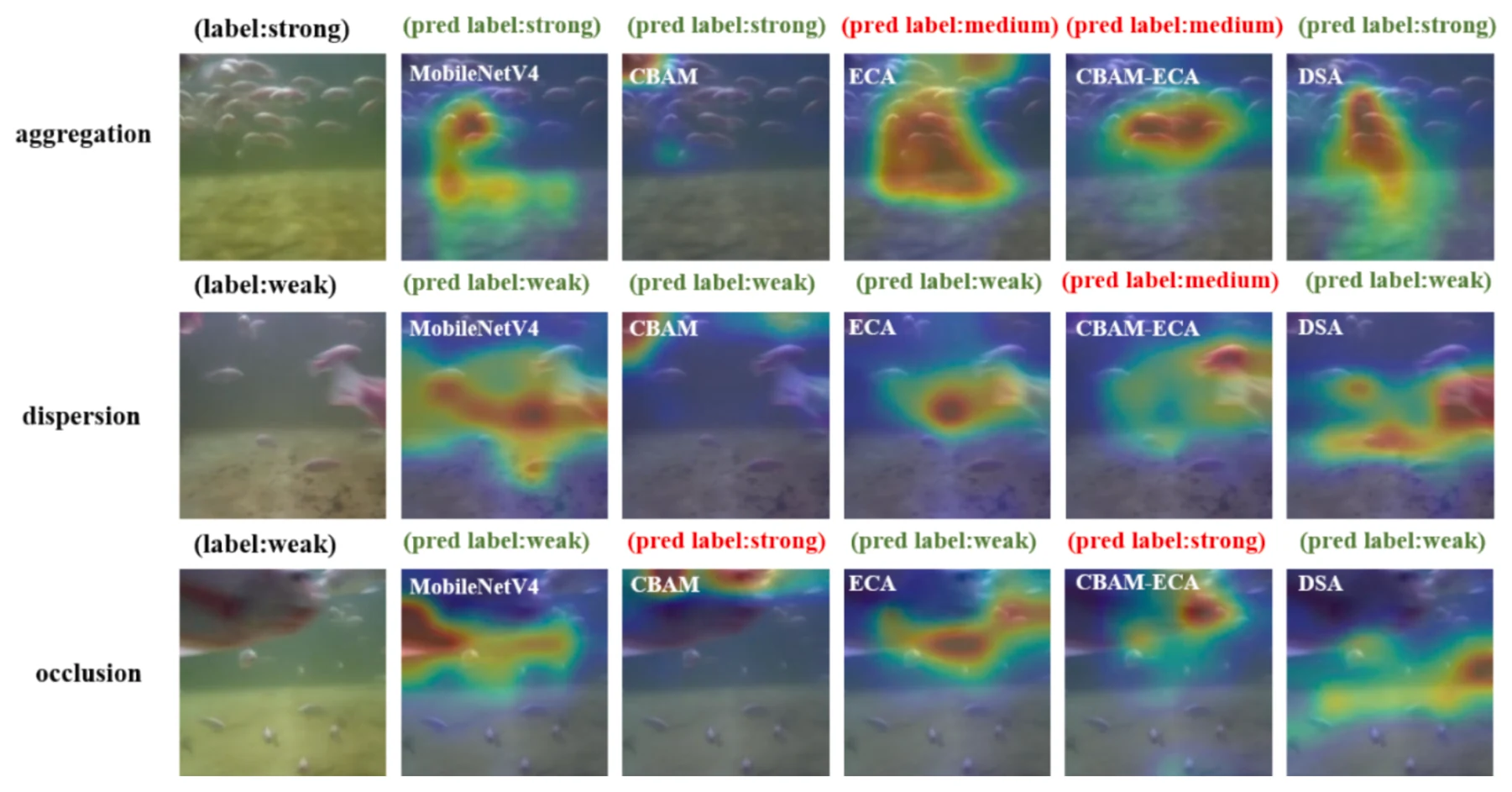
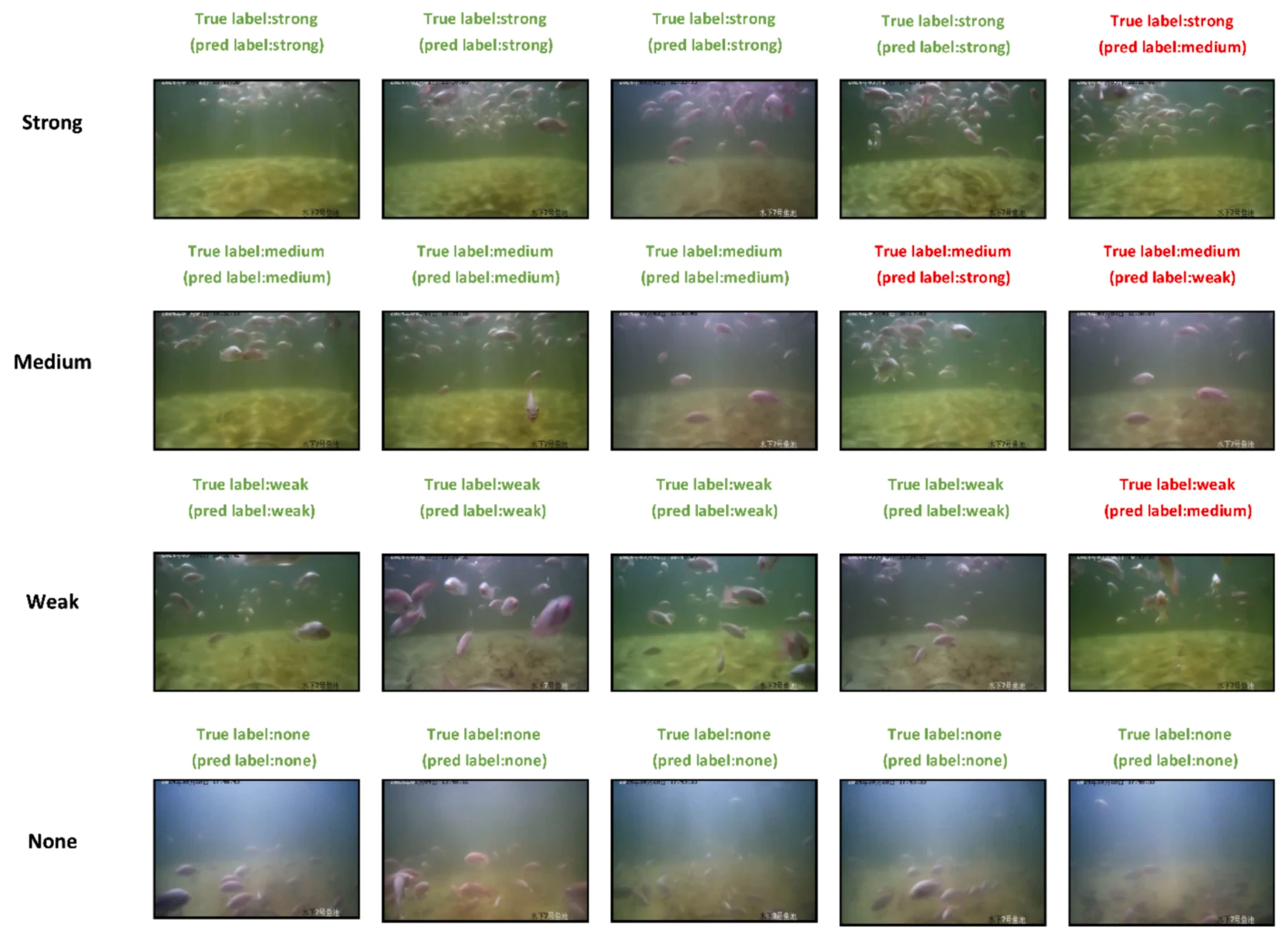
Figures 4, 8, and 11 are from Zhang et al., 2026 under CC BY 4.0. The figures were cropped from the PDF and converted to WebP.